
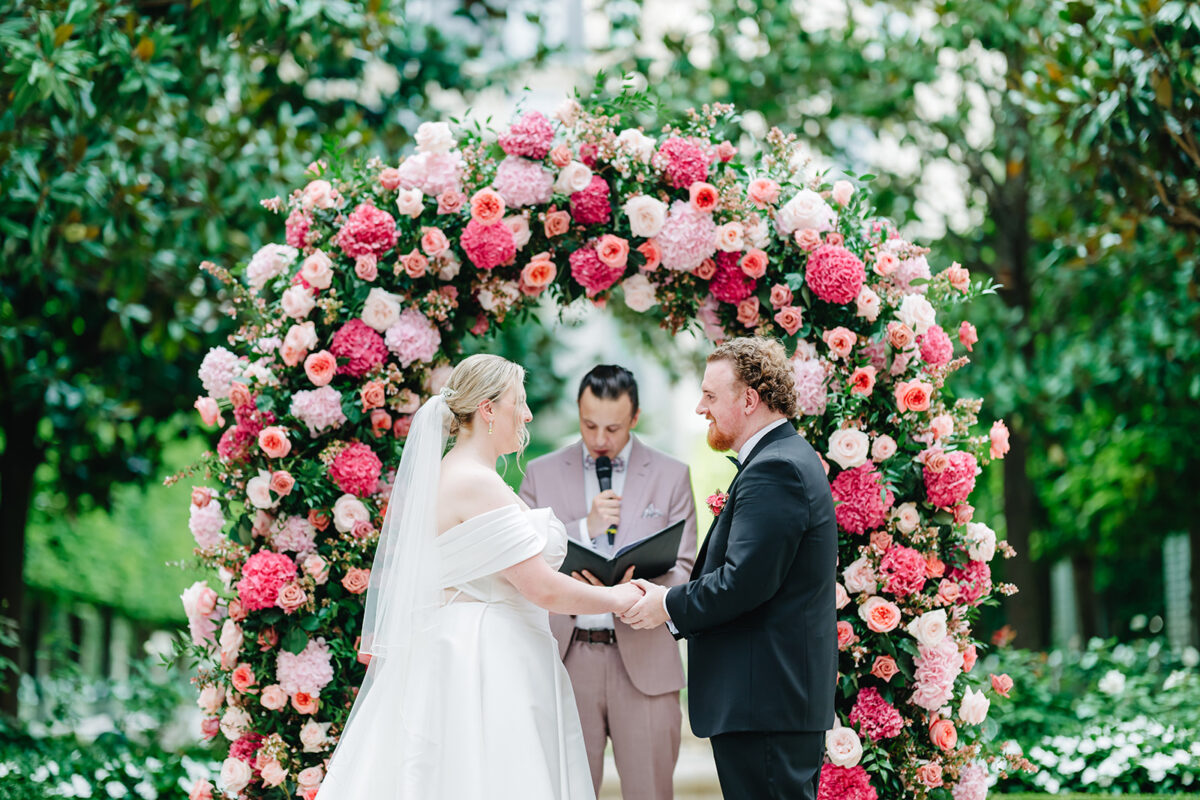
In short. WedVibes just ran a list of seven ceremony design ideas. I read it as the person who stands at the front, with a microphone and a folder. Each design changes something the guests will never think about: how the words travel, where the light falls, who sees whose face, and where I stand. If your design is bold, tell your planner and your celebrant early, and ask them the questions at the end of each section.
Source: « 7 Wedding Ceremony Design Ideas That Elevate the Whole Space » by Anna Ross, WedVibes, 2 November 2026. The ideas, the designs and the credits are theirs, and all rights stay with their authors. What follows is only my view from the front of the ceremony. I am a member of WedVibes.
What does a monochromatic ceremony change for the celebrant?
The article describes one colour from the floor to the flowers, with the couple in white standing out against it. From the front, that is the easiest picture to read: everyone knows where to look. I often match my suit to the decor, precisely so that I do not steal the show. A celebrant in the wrong colour becomes a stain in every wide shot; a celebrant in the right tone simply belongs to the picture. I wrote about this in The Matching Celebrant. So whenever there is a real colour scheme, I ask the planner for it early, and my suit, my folder and my microphone follow it.
Ask your planner: what is the palette, and can the celebrant have it a few weeks before the day?
What does draping do to the sound of a ceremony?
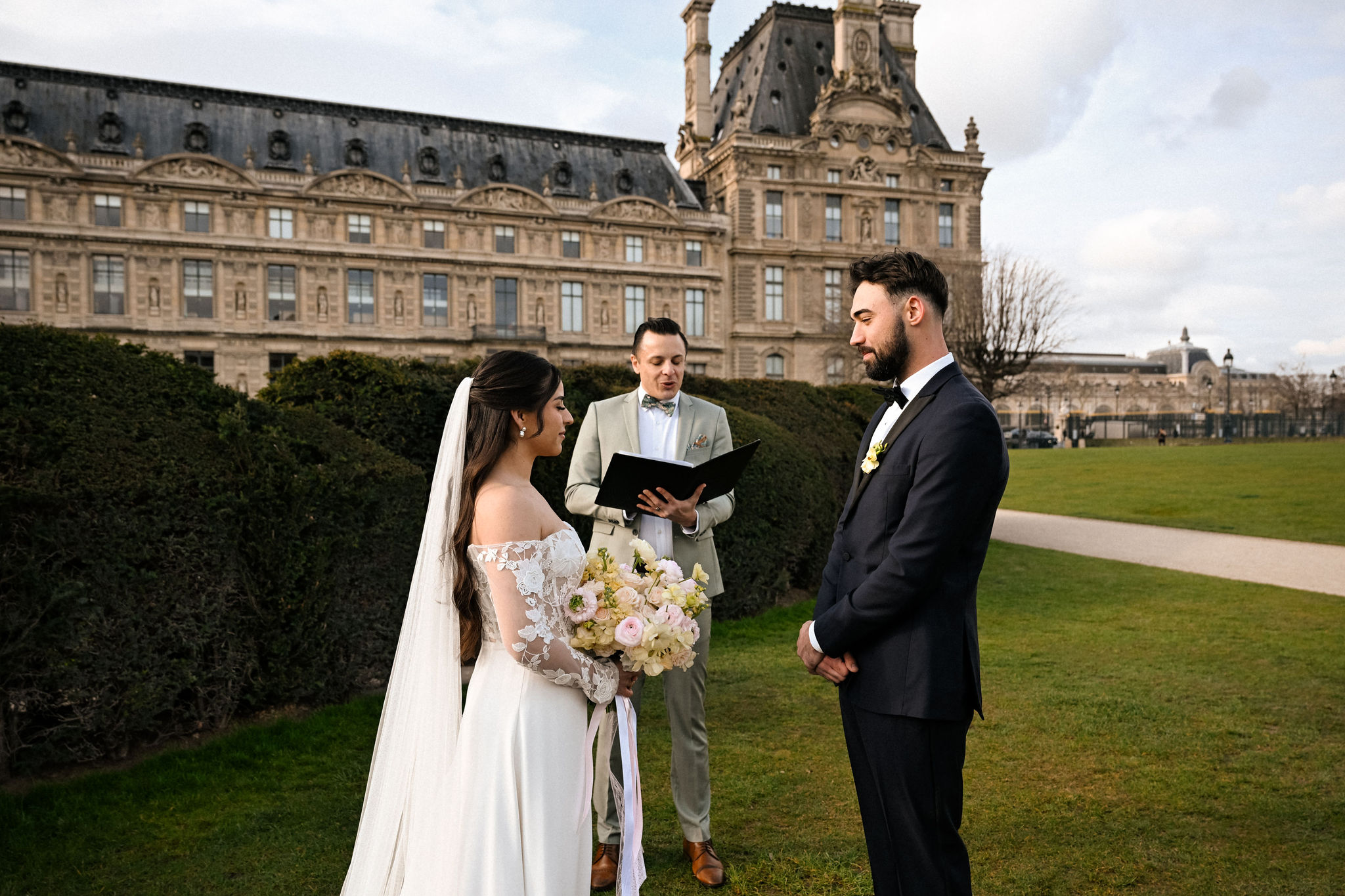
The article says fabric becomes the architecture: ceilings, walls, dressed chairs. Fabric also absorbs sound. A room that echoes is tiring, but a room that swallows the voice makes guests at the back lean forward and miss your vows. So I always do a sound check in the finished room, draped and with the chairs in place: I arrive at least one hour before the ceremony for that. Handheld, lapel or headset microphone, I adapt to all three. Hands free gives the ceremony more depth, so in a room full of fabric the lapel or the headset is often the better choice. That is a discussion to have early, not at the rehearsal.
Ask your celebrant: which microphone will you use, and when do you test it in the finished room?
Can a whimsical ceremony still carry serious words?
WedVibes writes that in a playful, storybook set, « the emotional moments hit even harder after all that joy. » I agree with the direction, and it changes how I write. The text needs the same weight as the decor, so I put the quiet part, the vows, after the lightest part. I never ask the room to be quiet. Attention does not come from authority; it comes from a short silence between two sentences, and the guests lean in by themselves. If everything is a joke, that silence does not work. If nothing is, the decor feels like a costume.
Ask your celebrant: where do we place the funniest and the most intimate moments?
What happens to a ceremony with mirrors and silver?
Reflective platforms and mirrored cubes for seating look great and move light around. For the celebrant that raises three practical questions. Where does the sun hit the mirrors at the time of the ceremony? Does anyone, the couple included, get a glare in the eyes during the vows? And who can see the reflection of whom? Check the direction of the light at the exact hour, on site, with the venue and the photographer. This is also where I ask where I should stand so that I am not doubled in every surface.
Ask your planner: have we looked at this space at the hour of the ceremony, and where does the light land?
Where does the officiant stand when there is a sculpture instead of an arch?
The article suggests art installations in place of the arch. An arch tells everyone where the couple stands. A sculpture does not, so you have to decide. I need to know in advance whether the couple faces the guests with the piece behind them, or whether they stand beside it. I also need a place that is not in front of it. That is a ten-minute conversation, and it saves a lot of improvisation.
Ask your celebrant: where do you stand, and does the couple face the guests or the work?
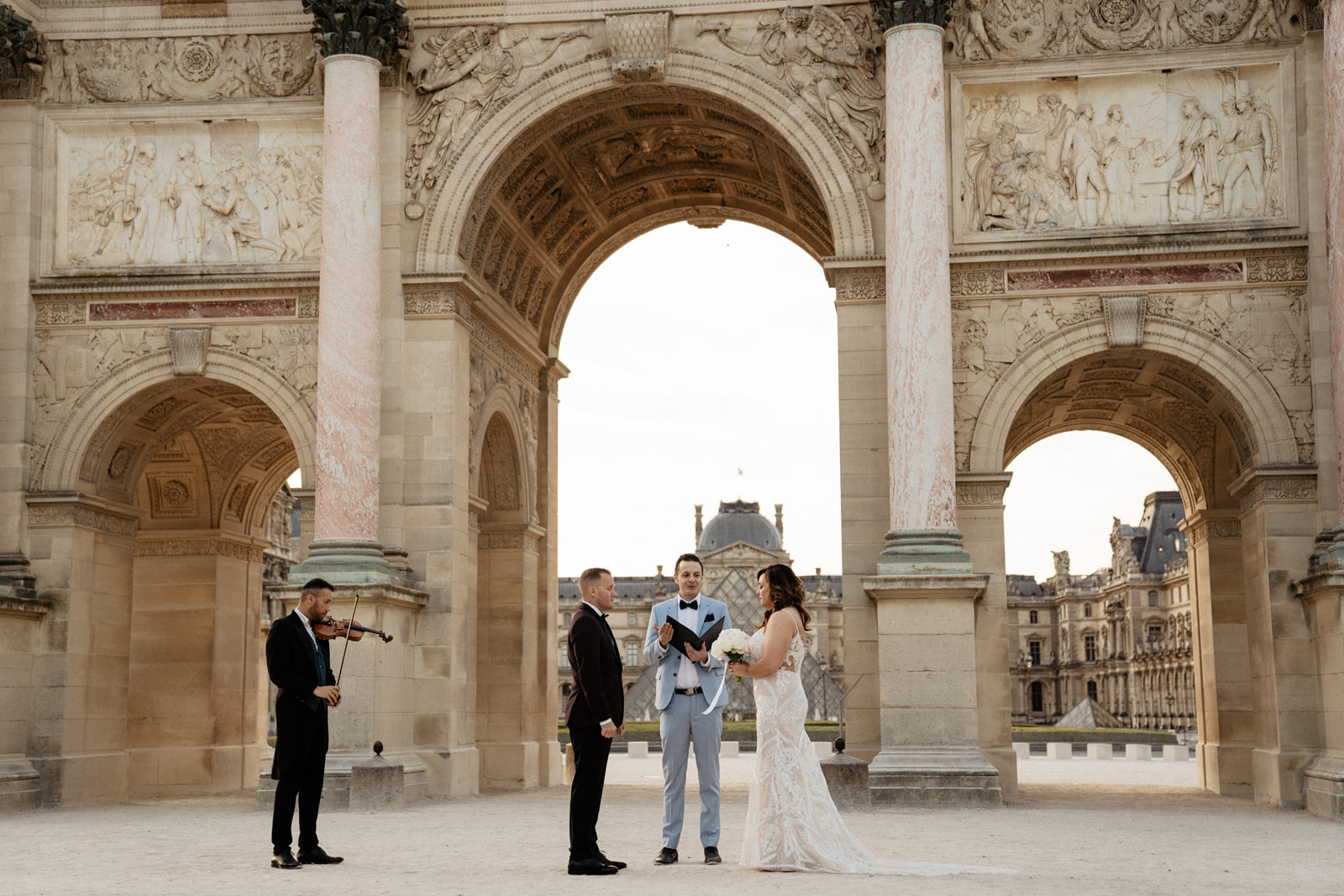
Does playing with colour change how a ceremony is read?
Two shades or a whole palette. Colour is the part of the design where guests tell each other « look at this » before the ceremony begins. I use that. I begin when the room has had its moment of looking around, not before. Then the words get the attention. Ask your planner for the timing: how long do guests have between taking their seats and the first word?
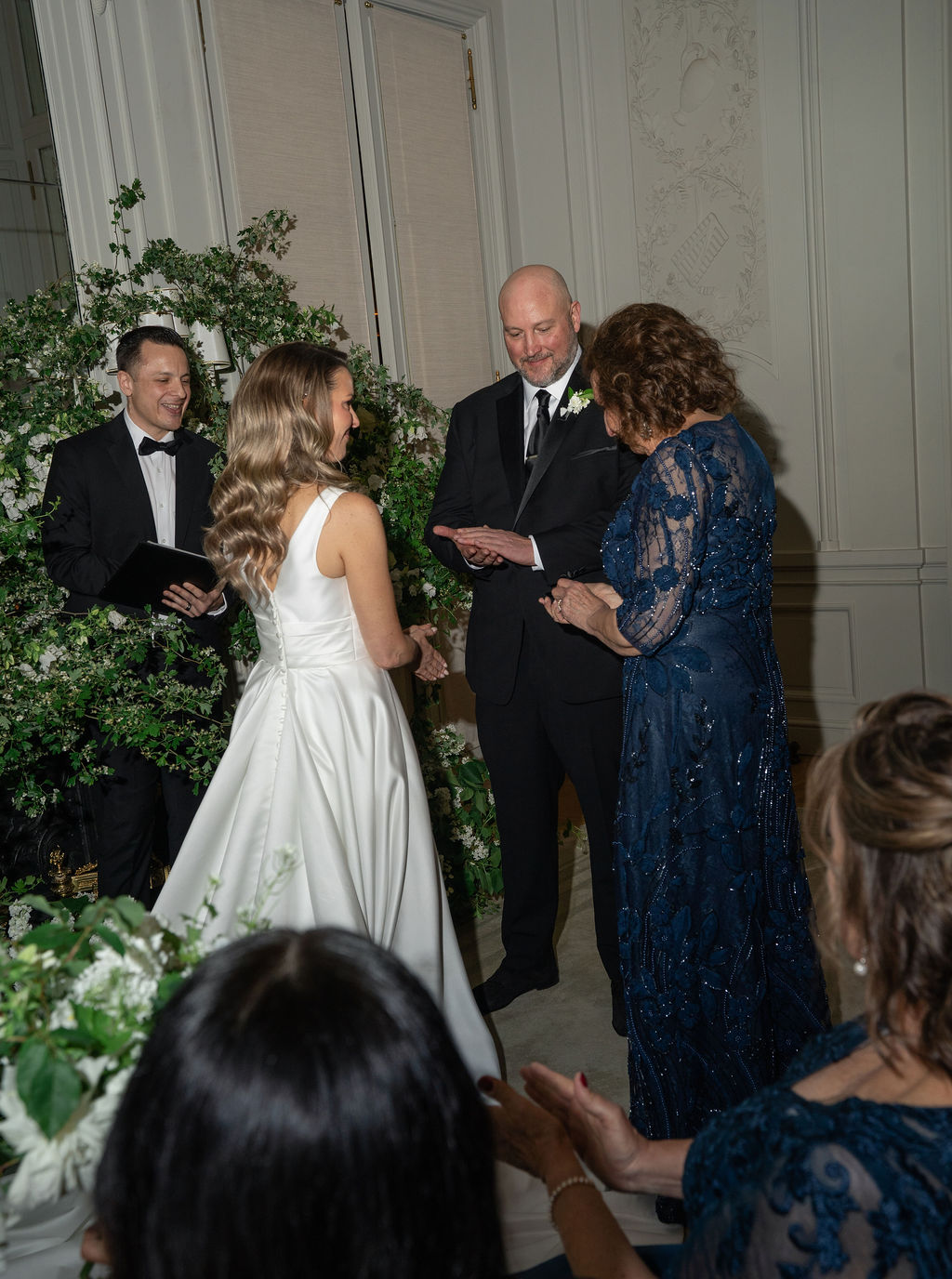
What does a ceremony built on flowers ask from the officiant?
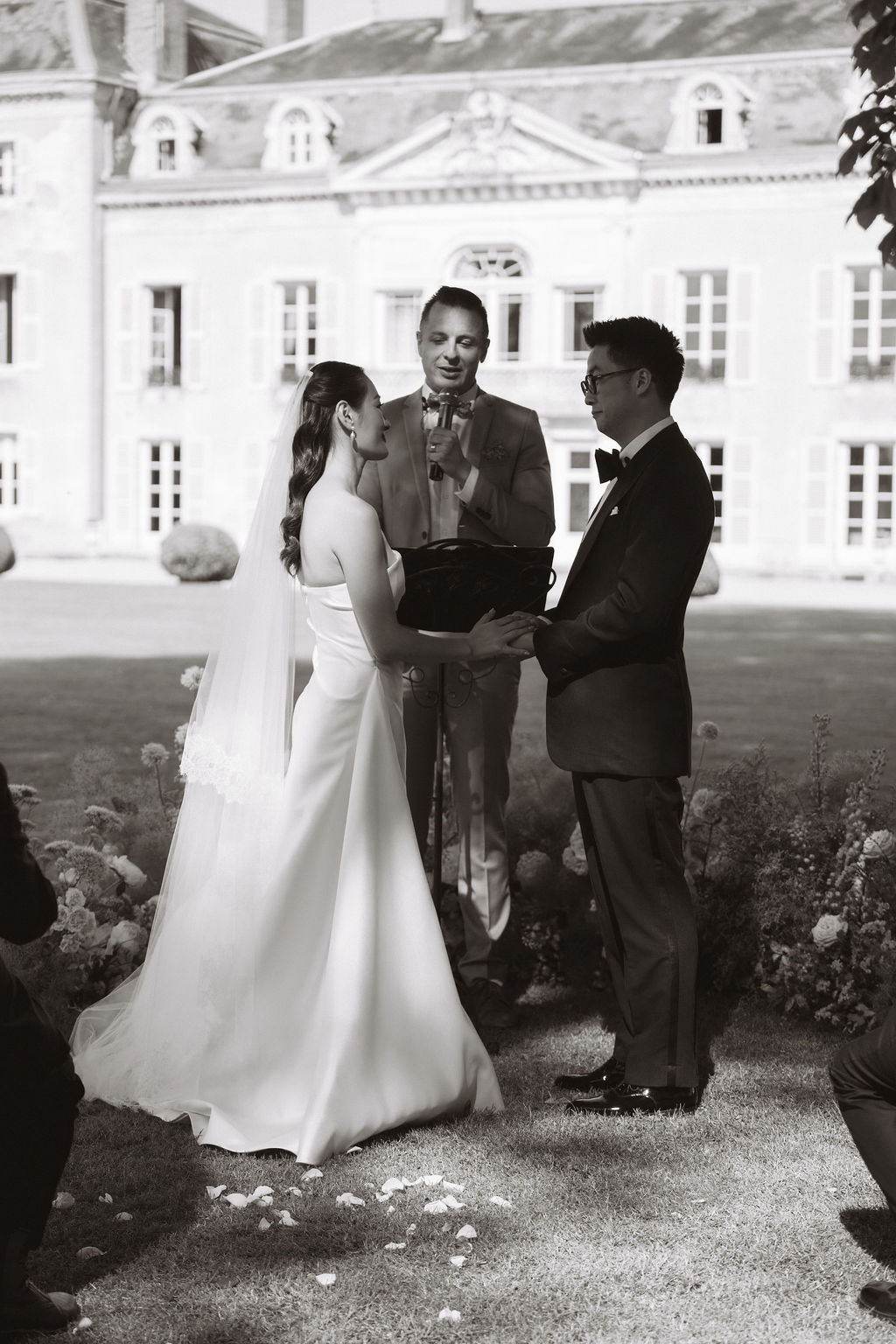
The last idea in the article is flowers as structure. At the Château de Tourreau in Provence, for Virithipa and Nick, flowers ran low along both sides of the aisle, and I officiated between them with a handheld microphone while the veil lifted in the wind.
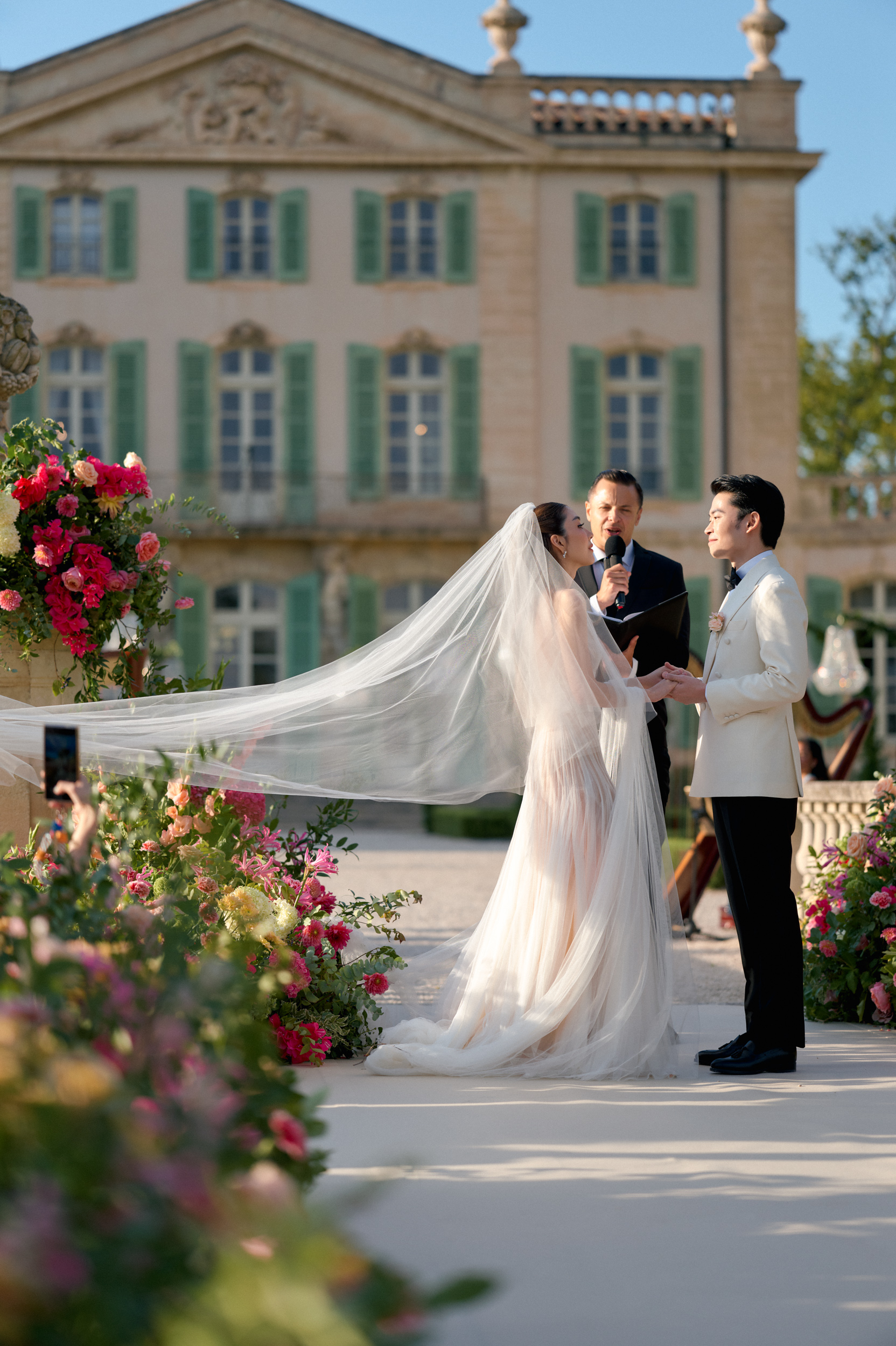
A big floral structure changes two things for me. It can hide a microphone stand or a cable, so I ask where they go. And low flowers on the ground are in the way of a long veil or a long dress, so we rehearse the steps. These are small things, and flowers are not an obstacle. They simply need a plan.
Ask your planner: where do the microphone and the cables go, and what is placed at the steps?
What should you tell your officiant about the ceremony design?
Three things, whatever the idea: the position of the couple in the space, the sound plan, and the hour of the light. I made a short checklist of what to send me, and I will share it with you when you write.
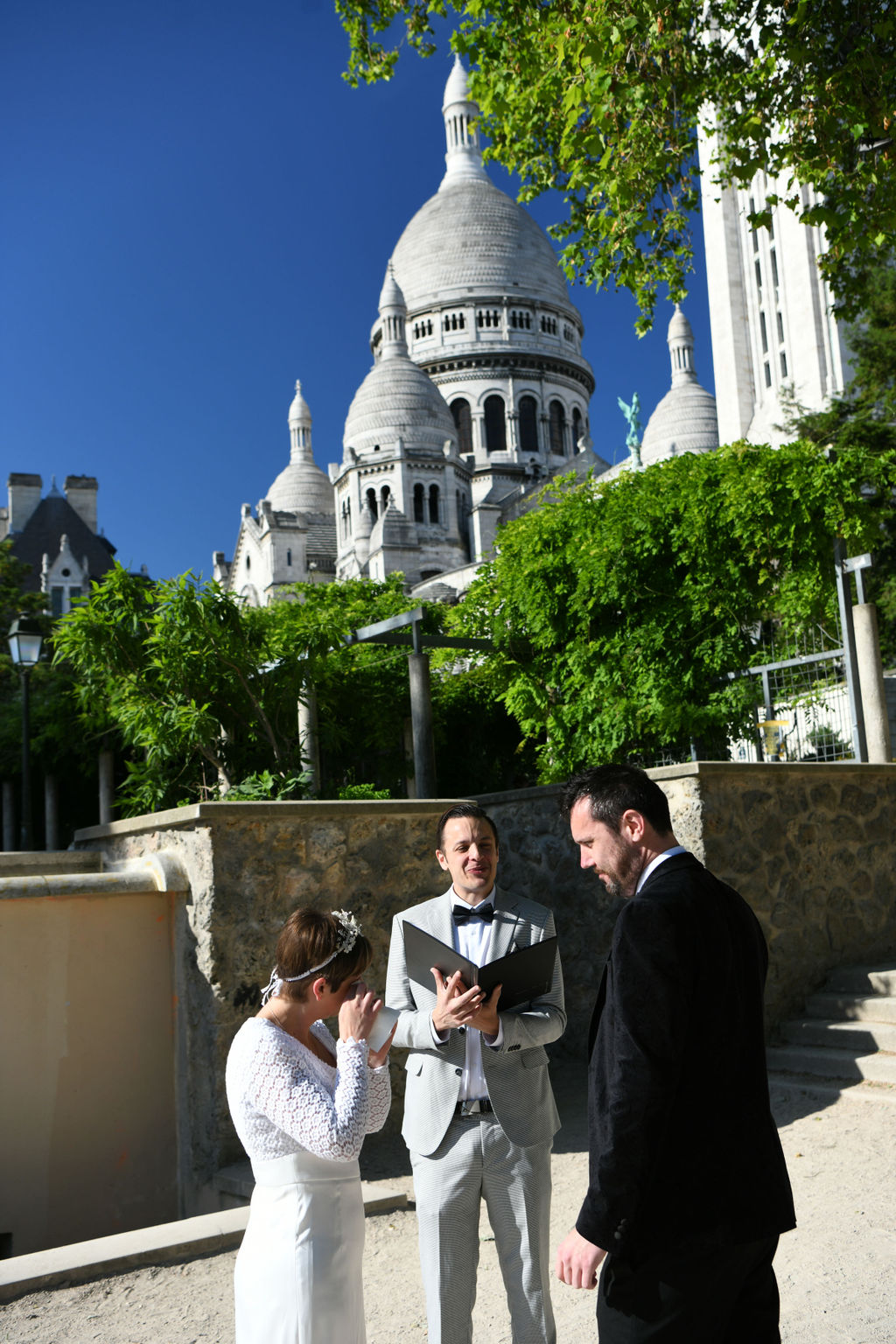
Photographs on this page, all from ceremonies I officiated: Alyssa Belkaci (@alyssabelkaciphoto) (Tuileries), Honey Wasp Weddings (@honeywaspweddings) (Château de Varennes), @missparisphoto (Montmartre), Through The Glass (@throughtheglassparis) (Arc du Carrousel, planning The Paris Elopement (@thepariselopement)), Janna Brown (@jannabrownco) (Paris), Linas Dambrauskas (@linasdambrauskas) (Château de Tourreau), and Morgane Ball (@morganeballphotography) for the cover, at the Ritz Paris (@ritzparis), planning Momento Mio (@momentomio_weddingplanner), flowers Anne Vitchen (@anne.vitchen). Design ideas from the WedVibes article by Anna Ross (@wed_vibes); credits for each design are given in the original article.
Want to talk about your ceremony design?
If you are planning a ceremony in Paris, tell me the date, the venue and the design. Contact me here, I reply personally within 24 hours.
Related: Your Paris wedding ceremony, Destination wedding officiant, Paris wedding venues, Portfolio.

Planning your ceremony in France?
Tell me your date and your story. I read every message myself and write back personally within 24 hours.
Get your personal quote within 24 hours